What if we removed all the foreigners?
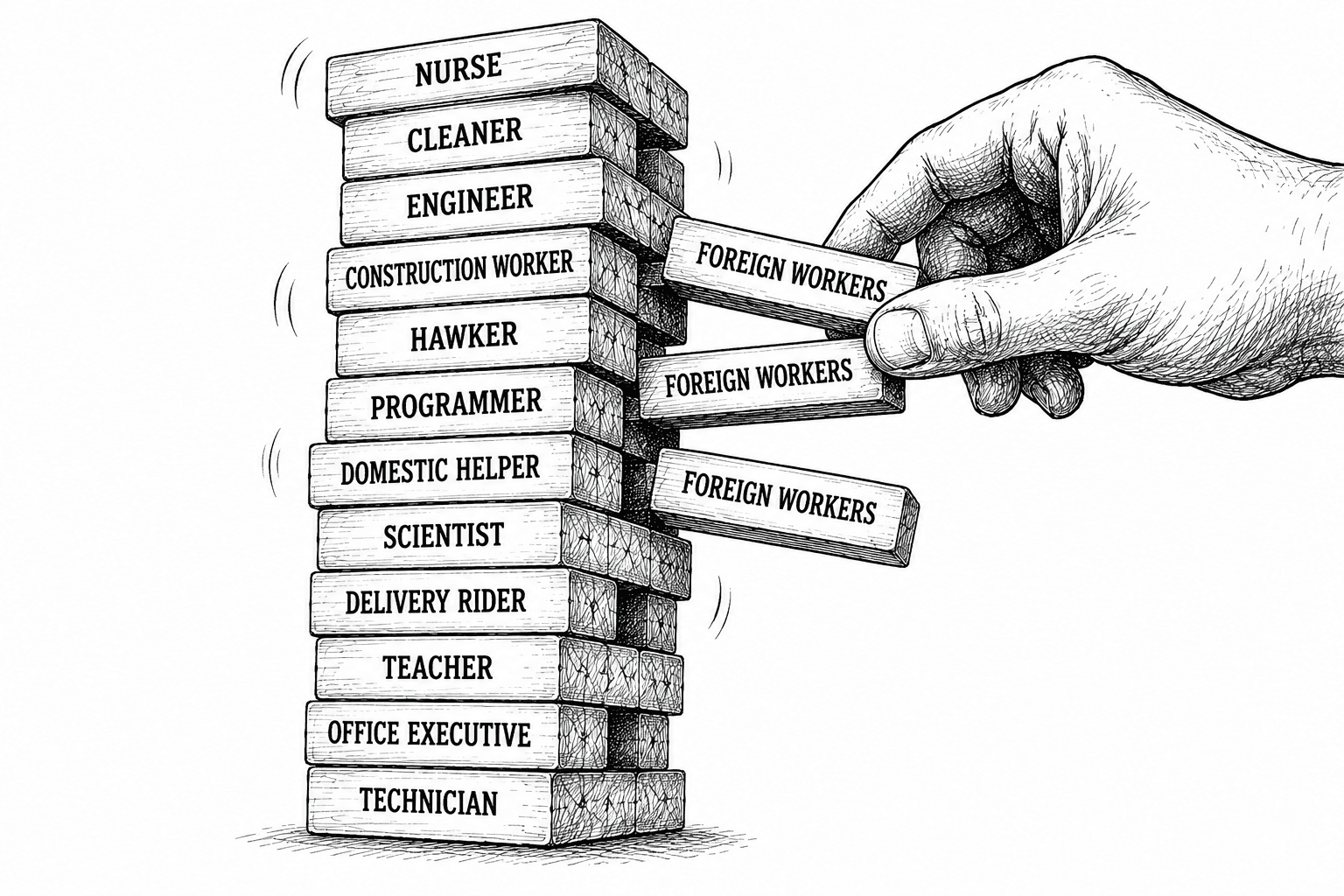
𝐎𝐮𝐭 𝐰𝐢𝐭𝐡 𝐭𝐡𝐞 𝐟𝐨𝐫𝐞𝐢𝐠𝐧𝐞𝐫𝐬!
Every now and then, you see the “locals vs foreigner” complaints. Foreigners are taking our jobs. Foreigners are causing crowded trains. Foreigners are driving up property prices.
It is as if reducing the number of foreigners, and everything will magically become better.
Sure, whilst reducing the numbers is an emotionally satisfying argument, it is also an economically shallow one.
𝐋𝐞𝐭'𝐬 𝐢𝐦𝐚𝐠𝐢𝐧𝐞 𝐏𝐚𝐫𝐥𝐢𝐚𝐦𝐞𝐧𝐭 𝐠𝐚𝐯𝐞 𝐢𝐧 𝐭𝐨 𝐩𝐨𝐩𝐮𝐥𝐚𝐫 𝐩𝐫𝐞𝐬𝐬𝐮𝐫𝐞 𝐭𝐨𝐦𝐨𝐫𝐫𝐨𝐰 𝐚𝐧𝐝 𝐚𝐧𝐧𝐨𝐮𝐧𝐜𝐞𝐝 𝐭𝐡𝐚𝐭 𝐭𝐡𝐞 𝐟𝐨𝐫𝐞𝐢𝐠𝐧 𝐰𝐨𝐫𝐤𝐟𝐨𝐫𝐜𝐞 𝐰𝐨𝐮𝐥𝐝 𝐛𝐞 𝐜𝐮𝐭 𝐛𝐲 𝟓𝟎%.
First, companies would have no choice but to hire locally for many of those roles. With fewer workers available, wages would naturally rise as businesses compete for talent.
That sounds wonderful right? Well, who pays those higher wage bills. You do.
The cost of labour doesn't disappear. It gets passed on through higher prices for your food, transport, healthcare, childcare, renovations, logistics, retail, and practically every service you use.
Second, manpower is the single largest expense for many businesses. Increase labour costs dramatically, and you make entrepreneurship far riskier.
Want to start a new café? Where is your source of manpower?
Starting a small business in cleaning, manufacturing and landscaping? Who’s going to do this work?
Even if you’re talking about the much criticized financial services industry, there just aren’t enough Singaporeans to support all these banks and financial organizations.
You’ll discover that businesses simply won't be created at all. Ironically, policies meant to "protect jobs" can end up preventing new jobs from ever existing.
Third, many multinational companies don't have to stay here. If Singapore becomes too difficult or too expensive to staff… especially for specialist, engineering, research or regional management roles, they simply relocate.
When headquarters leave, they don't just take away a handful of expatriate positions.
They take away HR staff. Finance teams. Receptionists. IT support. Marketing. Facilities management.
Local suppliers will suddenly find no business to do. Entire ecosystems disappear together.
Fourth, Singapore's reputation matters. We are a country that depends on international trade, international investment and international talent. If we become known for being openly hostile towards foreigners, should we be surprised if other countries begin treating Singaporeans the same way?
Finally, there's the simple issue of consumption.
Suppose there are one million foreigners living here and imagine each spends just ten dollars a day.
That's ten million dollars circulating through Singapore's economy every single day.
All of Singapore economy depends on this spending: coffee shops, hawker centers, hair salons, gyms, taxi/PHV drivers, food delivery, landlords… take all that away and you will feel the pain.
It is unfortunate that Singapore’s fate, is that it is a small land scarce country. Small body, but big capabilities - we are just outpacing our own economic ability.
The complaints and criticisms are real and should not be ignored.
Infrastructure must keep pace with population, yes but at the same time, this country can only contain so many inhabitants.
𝐅𝐢𝐯𝐞𝐒𝐭𝐚𝐫𝐬𝐀𝐧𝐝𝐀𝐌𝐨𝐨𝐧 𝐢𝐬 𝐨𝐟 𝐭𝐡𝐞 𝐩𝐨𝐬𝐢𝐭𝐢𝐨𝐧 𝐭𝐡𝐚𝐭 𝐰𝐞 𝐧𝐞𝐞𝐝 𝐝𝐞𝐜𝐞𝐧𝐭𝐫𝐚𝐥𝐢𝐳𝐞𝐝 𝐠𝐫𝐨𝐰𝐭𝐡, 𝐯𝐢𝐚 𝐬𝐚𝐭𝐞𝐥𝐥𝐢𝐭𝐞 𝐜𝐢𝐭𝐢𝐞𝐬. If growth cannot be achieved here, we must pursue it via a new model of governance. But that is a separate topic for another post.
The debate should never be "locals versus foreigners."
It should be: How do we build an economy where Singaporeans thrive while remaining open enough to attract the people and businesses that keep that economy growing?
Satellite cities may just be the answer.
#singapore