𝐓𝐡𝐞 𝐕𝐨𝐢𝐝 𝐃𝐞𝐜𝐤 𝐈𝐬 𝐓𝐡𝐞 𝐌𝐨𝐬𝐭 𝐒𝐢𝐧𝐠𝐚𝐩𝐨𝐫𝐞𝐚𝐧 𝐍𝐚𝐦𝐞 𝐖𝐞 𝐂𝐨𝐮𝐥𝐝 𝐏𝐨𝐬𝐬𝐢𝐛𝐥𝐲 𝐇𝐚𝐯𝐞 𝐈𝐧𝐯𝐞𝐧𝐭𝐞𝐝
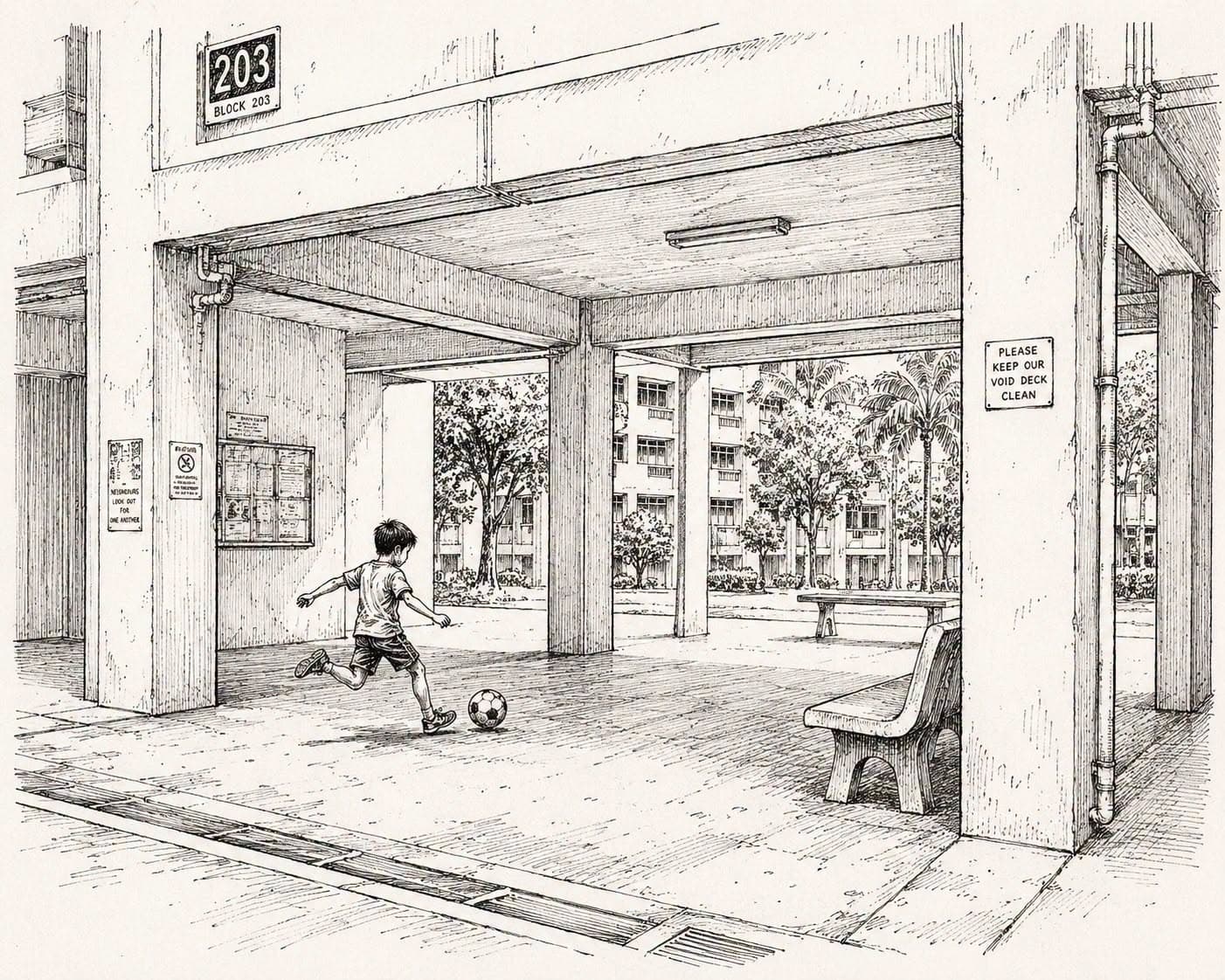
There is perhaps no better symbol of Singapore than the humble void deck.
Other countries might have called it the Community Plaza. Village Hall. The People's Court. Heritage Commons.
We looked at the empty space beneath a block of flats and collectively decided:
Well. It's a deck. And it's void. Ok, void deck.
It is probably the most deadpan piece of architecture ever named.
Yet that tiny linguistic decision says something much larger about us.
Singapore is, at heart, an extraordinarily utilitarian society. We have an almost instinctive preference for function over flourish, precision over poetry, and clarity over creativity.
Even our government agencies sound like they were assembled by engineers rather than poets.
The Housing Development Board develops housing.
The Land Transport Authority manages land transport.
The Public Utilities Board handles utilities.
The Monetary Authority manages money.
Every institution does exactly what it says on the packaging.
Our architecture follows the same philosophy.
A multi-storey car park.
A hawker centre.
One suspects that if the Eiffel Tower had been designed here, it might have been called the Tall Steel Viewing Structure.
In other countries, they take much more creative liberty.
For example in South Africa, the traffic lights are called "robots".
In the United Kingdom they have names such as the Home Office, the Treasury and lovingly call their trains, the Tube.
In the United States you have Department of the Interior, State Department and Homeland Security.
Singaporean policies often read like an operating manual.
This practicality has served Singapore incredibly well. It transformed a resource-poor island into one of the world's most orderly, prosperous and liveable countries. Problems are identified, processes are designed, and systems are built to work.
But we can be a bit more creative lah.
As children, we are rewarded for arriving at the right answer. At work, consistency earns promotions. In government, ambiguity is something to eliminate rather than embrace.
This makes us take very functional, boring approaches to problems.
"What if people don't understand?"
Over time, we become very good at only colouring inside the lines.
Ah yes, that also explains why Singapore loves templates.
Proposal templates. PowerPoint templates. Meeting minutes templates.
Have you seen satire pages in Singapore? Very few people understand them. Most people are just wondering why on earth this weird news is taking place.
Anyway, this is not criticism.
The same instincts that make Singapore painfully literal also make it exceptionally competent.
When the train timetable says 8:03, people expect 8:03. Late one minute only, Straits Times going to receive a few angry forum letters.
When a sign says "No Durians", remarkably few people attempt to test the boundaries of what qualifies as a durian.
But as Singapore matures, perhaps we can afford to loosen our grip just a little.
Not every public space needs to sound like an instruction manual.
Not every policy needs a three-letter acronym.
Not every idea needs a precedent before it deserves consideration.
Sometimes creativity requires a little ambiguity.
Sometimes humour requires trusting people to get the joke.
Sometimes the best ideas emerge when we stop asking whether something has been done before.
The void deck will probably always be called the void deck.
And perhaps that's perfectly Singaporean.
But maybe, just maybe, it's time we became a little less afraid of naming — and imagining — things that are more than simply what they do.