Why Are Free Things So Attractive To Us?
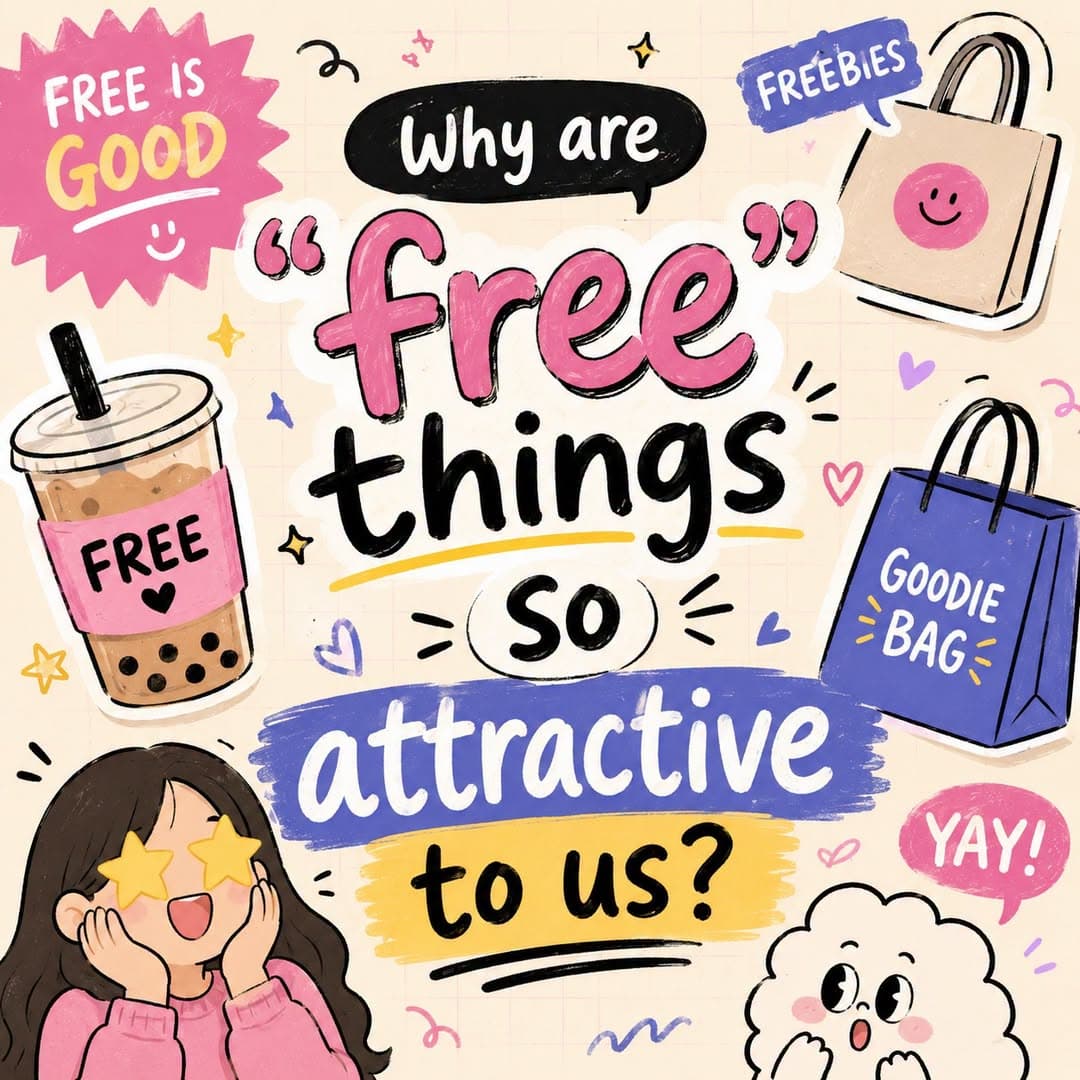
Nothing attracts a crowd quite like the word 𝐟𝐫𝐞𝐞.
Offer a free tote bag and people will queue. Offer free food at an event and attendance mysteriously doubles. Put a box of free samples in a supermarket and otherwise rational adults will happily stand around waiting for a tiny cup of yogurt worth twenty cents.
What's going on?
It turns out that "free" does something strange to the human brain.
Behavioural economist Dan Ariely famously found that people do not evaluate free items the same way they evaluate discounted items. A chocolate priced at 1 cent and another priced at 15 cents will be compared rationally. But make the first chocolate completely free and demand suddenly explodes.
The value of the item has not changed very much. The psychology has.
When something costs nothing, we perceive there to be no downside. The possibility of loss disappears. Humans are naturally loss-averse; we dislike losing more than we enjoy gaining. A free item feels like pure upside.
Even if we don't need it.
Especially if we don't need it.
That's why many Singaporean households have entire collections of event goodie bags, free notebooks, corporate water bottles, reusable shopping bags, and random souvenirs accumulated over decades. The value was often never in the item itself. The value was in obtaining something without paying.
When something valuable became available at no cost, grabbing it was often the rational thing to do. Those instincts evolved long before supermarkets, online shopping and corporate roadshows existed. The modern free muffin at a seminar is triggering ancient instincts designed for survival.
In some ways, the queue itself becomes part of the attraction.
𝐒𝐢𝐧𝐠𝐚𝐩𝐨𝐫𝐞𝐚𝐧𝐬 𝐨𝐟𝐭𝐞𝐧 𝐣𝐨𝐤𝐞 𝐭𝐡𝐚𝐭 𝐢𝐟 𝐭𝐡𝐞𝐫𝐞 𝐢𝐬 𝐚 𝐪𝐮𝐞𝐮𝐞, 𝐢𝐭 𝐦𝐮𝐬𝐭 𝐛𝐞 𝐠𝐨𝐨𝐝.
There is some truth to this.
When we see many others lining up for something, we assume it has value. Psychologists call this social proof. If 200 people are willing to stand in line for a free goodie bag, perhaps there is something worthwhile inside.
Sometimes there isn't.
But the queue itself becomes evidence.
This also explains why event organisers love free food. Offer free food and people flock to your event.
A free lunch does more than fill stomachs. It signals generosity. It lowers the perceived cost of attendance. It creates a feeling that people are getting a bargain. An event offering sandwiches often appears more attractive than an equally valuable event without them.
Universities know this. Political parties know this. The People’s Association most definitely knows this.
The economics of free food have been studied for decades, and the conclusion is remarkably consistent: people show up.
Yet perhaps the most interesting thing about freebies is that they reveal something deeper about how we think about value.
A person might refuse to buy a $2 curry puff on an ordinary day. But the same person might spend 45 minutes queuing for a free curry puff at a promotional event.
Economically, that makes little sense. The value of 45 minutes of time is probably far greater than $2.
But humans are not calculators. We are storytellers!
The story you tell yourself in your mind, is not that you saved $2. The story you tell yourself is “I got this for free!”
So there we go: it’s an open secret really. That is why every event gives a free tote bag, a free buffet, a free goodie bag and and a free sample.
The item itself is not the point, it’s the feeling of getting something for nothing that’s worth a hundred dollars.
However - is your time worth the effort getting that freebie? Now that’s something to think about.