It’s hard to imagine it, but once upon a time, Singapore had a tiger infestation problem.
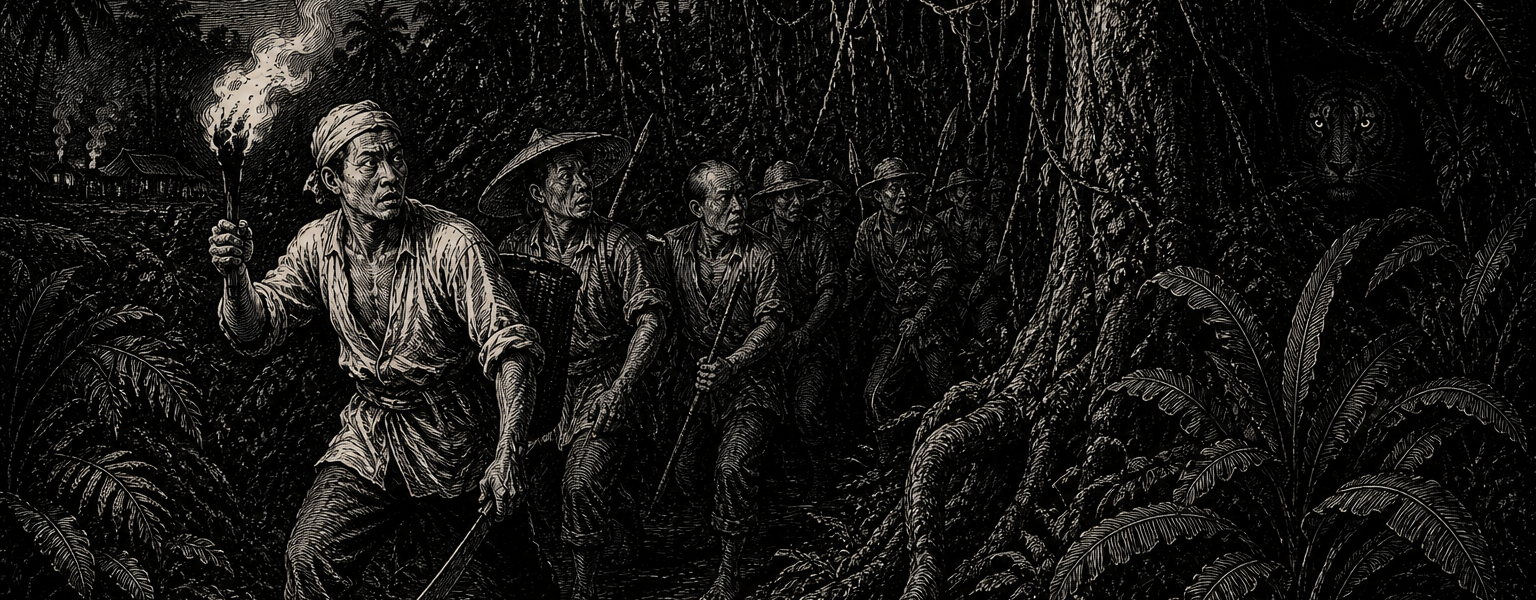
Historical accounts from the mid-1800s describe tiger attacks happening with alarming regularity. Workers disappeared while collecting firewood. Farmers vanished along jungle paths. Bodies were found partially eaten near plantations.
Some reports claimed that hundreds of people died annually from tiger attacks in Singapore and the Malay Peninsula, though historians debate the accuracy of these numbers. Colonial newspapers often sensationalised attacks, and record-keeping was inconsistent.
Colonial newspapers carried these headlines:
“Coolie Dragged into Jungle”
“Man Devoured Near Plantation”
“Tiger Shot after Reign of Terror”
And the colonists loved the tiger hunt. Successful tiger hunters became local celebrities. Some used bait traps. Others organised hunting parties with guns and dogs. There were even rewards for killing tigers.
In the 1800s, much of the island was still covered in dense secondary jungle and swamp. The air was thick with mosquitoes. Roads were muddy tracks. Entire areas were difficult to traverse after rain. Villages sat isolated from one another by vegetation so dense it could swallow sound.
What transformed the island was agriculture.
Large gambier and pepper plantations spread rapidly across Singapore after Stamford Raffles established the trading post in 1819. These plantations needed labor, and thousands of migrant workers, particularly Chinese coolies, arrived to clear forests and work the land.
Ironically, the plantations may have helped create perfect hunting grounds for tigers.
As forests were partially cleared, the landscape became fragmented. You now have patches of jungle meeting plantation edges. Guess where Shere Khan would go if he needed a snack?
𝐈𝐧 𝐟𝐚𝐜𝐭, 𝐎𝐫𝐜𝐡𝐚𝐫𝐝 𝐑𝐨𝐚𝐝 𝐰𝐚𝐬 𝐨𝐧𝐜𝐞 𝐭𝐢𝐠𝐞𝐫 𝐜𝐨𝐮𝐧𝐭𝐫𝐲.
It’s hard to imagine it, but in the 1800s, there were no luxury malls and tourists carrying shopping bags.
Bukit Timah was dense jungle and Thomson Road cut through wilderness.
Tiger attacks disproportionately affected migrant laborers.
That’s because most of these laborers lived in huts near plantations, travelled alone or in small groups and worked before sunrise and after sunset. Neither did they have weapons nor did their employers bother with protection.
They were poor, in debt and really were disposable within this colonial economic system. To the British, tiger attacks were just a labor-management issue.
What happened to the tigers? The island became populous. Forests were cleared, plantations expanded, roads grew and wildlife corridors vanished. At the same time, tigers were hunted aggressively whilst human density exploded.
The last known wild tiger in Singapore was reportedly shot in the early 20th century.
It’s pretty cool if you think about it.
Only a few generations separate Marina Bay Sands from a world where your grandfather’s grandfather might have carried a kerosene lamp at night for fear something with teeth was waiting beyond the trees.