
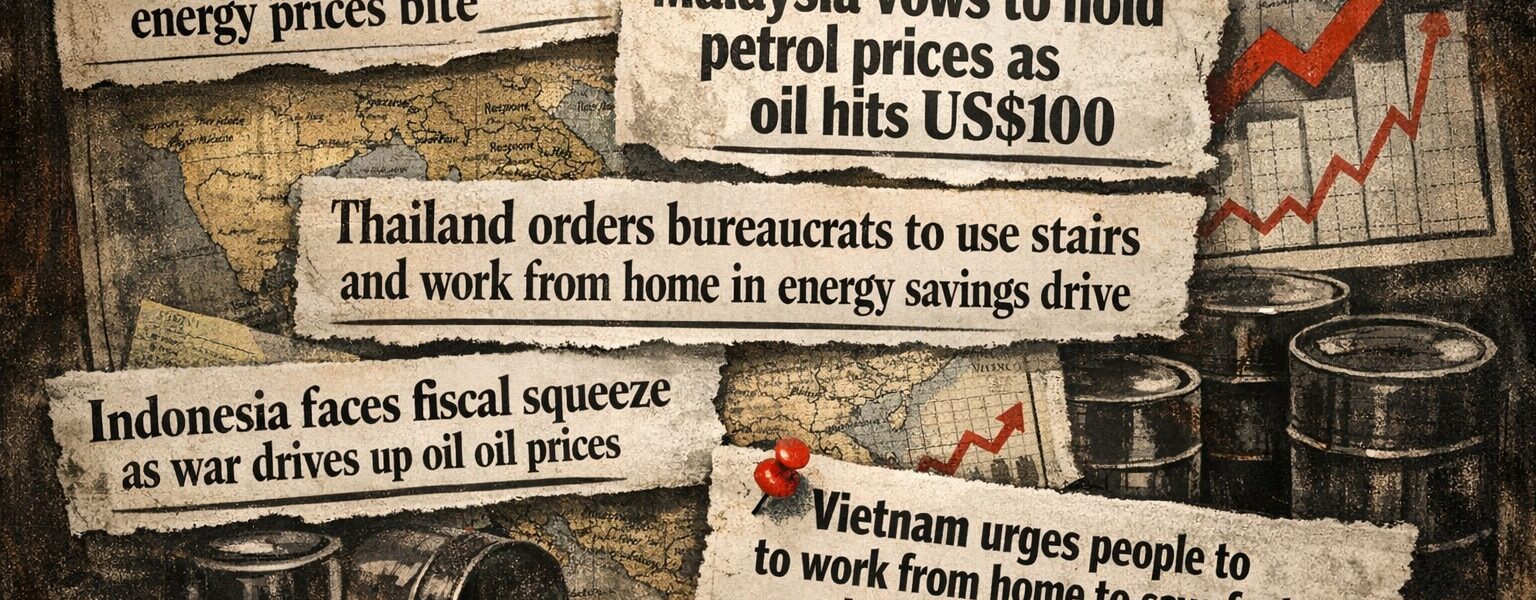
Across Asia this week, governments are scrambling to respond to rising global oil prices. Work weeks are being shortened. Work-from-home policies are being revived. Some governments are even asking civil servants to take the stairs instead of elevators.
But in Singapore, life continues almost completely unchanged.
Public transport runs normally. Offices remain open. Businesses continue operating. There are no emergency energy conservation orders.
If anything, the most visible complaint from Singaporeans so far is that petrol prices have risen again.
The contrast with the rest of the region is striking.
An Oil Shock Rippling Across Asia
The surge in oil prices is tied largely to instability in the Middle East and fears about disruption to the Strait of Hormuz, the narrow maritime chokepoint between Iran and Oman.
This waterway carries roughly 20% of the world’s oil supply and about one-third of global seaborne oil trade.
Even small disruptions there can move global markets dramatically.
Oil prices recently surged past US$100 per barrel, raising alarm across Asia, where many countries depend heavily on imported energy.
Governments are reacting quickly.
The Philippines has introduced a four-day workweek for government offices to reduce energy consumption.
Thailand has ordered civil servants to work from home and avoid elevators, encouraging staff to take the stairs as part of an energy-saving campaign.
Vietnam is urging businesses and citizens to cut fuel usage and shift toward remote work.
Malaysia is preparing to absorb the shock through petrol subsidies, even as global prices surge.
Indonesia faces growing fiscal pressure as rising oil prices increase the cost of maintaining its fuel subsidy program.
These measures reflect a difficult reality: energy price shocks can rapidly strain national budgets.
Why Fuel Prices Become a Fiscal Crisis
Many Southeast Asian governments subsidise fuel to keep petrol prices low.
This policy is politically popular but economically risky.
When oil prices spike, governments must either:
- Raise petrol prices (which angers voters), or
- Increase subsidies (which strains national budgets).
Indonesia provides a clear example.
In some years, fuel subsidies have consumed more than 10–15% of the government budget.
Malaysia’s fuel subsidy bill can run into tens of billions of ringgit annually during high oil price periods.
These systems make energy shocks not just an economic issue, but a political and fiscal crisis.
Singapore takes a very different approach.
Petrol prices here are not subsidised.
Instead, prices move largely in line with global markets. While this means Singaporeans pay more at the pump, it prevents the government from being trapped by runaway subsidy costs when oil spikes.
The Infrastructure Most People Never See
Singapore’s calm response to global oil shocks did not happen by accident.
It is the result of decades of investment in energy security infrastructure.
One of the most remarkable examples lies beneath Jurong Island.
The Jurong Rock Caverns (JRC) is Southeast Asia’s first underground hydrocarbon storage facility.
Carved 130 metres beneath the seabed, the caverns can store millions of barrels of crude oil and petrochemicals.
This underground storage system allows Singapore to:
• maintain strategic reserves
• buffer temporary supply disruptions
• support refinery operations during volatile periods
The caverns are part of a broader strategy to make Singapore a global energy trading and refining hub.
Jurong Island alone houses over 100 petrochemical companies, including major energy players like Shell, ExxonMobil and Chevron.
Diversified Energy Sources
Singapore is also far less dependent on a single energy source than many people assume.
Electricity in Singapore is generated primarily using natural gas, which accounts for roughly 95% of power generation.
But the gas itself is imported through multiple channels:
• Pipelines from Malaysia
• Pipelines from Indonesia
• Liquefied Natural Gas (LNG) imports from global suppliers
The Singapore LNG Terminal, opened in 2013 and expanded several times since, allows the country to import gas from global markets rather than relying on a single supplier.
This diversification significantly reduces vulnerability to regional disruptions.
Built-In Economic Shock Absorbers
Singapore’s resilience also comes from its broader economic structure.
The country maintains large financial reserves managed by GIC and Temasek Holdings, providing a powerful fiscal buffer in times of crisis.
These reserves allow the government to respond to economic shocks without destabilising national finances.
At the same time, Singapore’s economy is highly diversified.
Energy-intensive sectors exist, but the economy is heavily weighted toward services, finance, logistics, and technology—industries that are less sensitive to oil price swings than manufacturing-heavy economies.
The Reality: Prices Rise, But Systems Hold
That doesn’t mean Singapore is immune.
Higher oil prices still affect the country in several ways:
• Petrol prices rise
• Electricity tariffs increase (due to gas prices)
• Airfares climb
• Shipping and logistics costs increase
But these are price shocks, not supply crises.
Fuel remains available. Power continues to flow. The economy keeps running.
For most Singaporeans, the impact is felt mainly in higher costs rather than disruptions to daily life.
Perspective in a Time of Crisis
Moments like this reveal something important about how countries prepare for uncertainty.
Energy security is rarely visible when things are running smoothly. The infrastructure sits underground. The reserves sit quietly in sovereign funds. The policies often feel boring or even unpopular.
But when global shocks arrive, those long-term investments suddenly matter.
Across Asia today, governments are scrambling to conserve energy.
In Singapore, life goes on.
Sometimes the clearest sign of strong systems is that nothing dramatic happens at all.
📰 Regional headlines this week
Philippines starts four-day workweek to save energy
https://www.channelnewsasia.com/…/philippines-four-day…
Malaysia vows to hold petrol prices even as oil hits US$100
https://www.scmp.com/…/malaysia-vows-hold-petrol-prices…
Thailand orders bureaucrats to take the stairs and work from home to save energy
https://www.channelnewsasia.com/…/thailand-energy…
Indonesia faces fiscal pressure as oil prices surge
https://www.ft.com/…/a46b54e4-7d52-4aa6-b5c3-8217d3ee536d
Vietnam urges people to work from home and conserve fuel
https://www.ft.com/…/a46b54e4-7d52-4aa6-b5c3-8217d3ee536d
